
[Opinion] Electric bills have doubled. Here’s what Sacramento can do about it.
Irvine and other cities to consider supporting key reforms
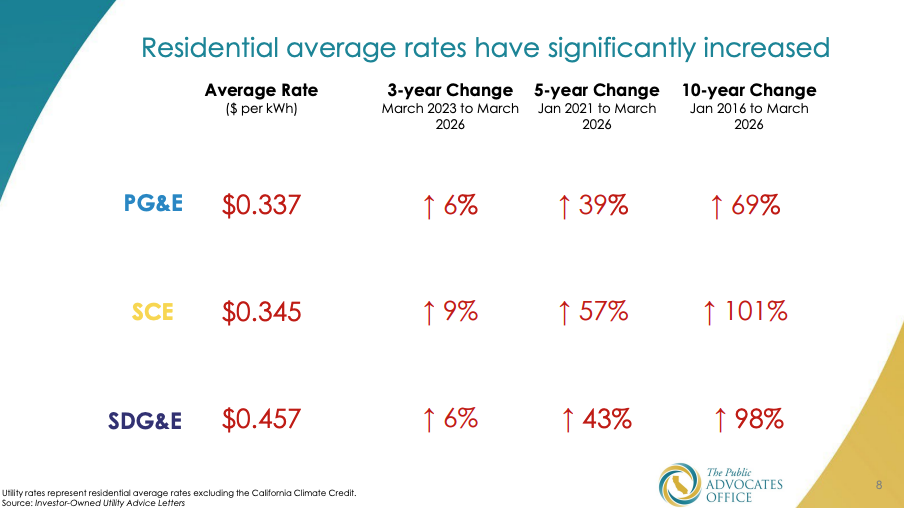
Orange County families are rationing electricity and soon will be going without AC in triple-digit heat because their power bills have doubled in just a decade. Nearly one in five Southern California Edison (SCE) customers are now behind on their bills by $833 on average.
While families struggle to keep the lights on, SCE is raking in record profits. SCE was the single most profitable investor-owned utility in the U.S. in 2025—pulling in over $5 billion in net income, a 200% increase from the year before. Irvine Councilmembers Kathleen Treseder and Betty Martinez-Franco joined residents and advocates at a protest against SCE’s skyrocketing profits outside Irvine City Hall in March, pledging to bring a resolution in support of critical affordability reforms now under consideration in Sacramento. The resolution will be considered at Irvine’s June 9 council meeting.
SCE doesn’t earn more by keeping your bills low. It earns more by spending more—and then charging you for it. California needs lawmakers who are willing to confront that broken incentive at its root.
Assemblymember Cottie Petrie-Norris, who represents Irvine, Costa Mesa and Tustin, has been a leader on utility reform with a suite of bills including AB 825, which she authored, to increase grid reliability and reduce electricity bills. Recognizing more work is needed this year, Asm. Petrie-Norris – who is Chair of the Assembly Utilities and Energy Committee – has the power to shape several other critical bills that can deliver the protections ratepayers need.
Assembly bill 2463, also introduced by Assemblymember Petrie-Norris, would require the California Public Utilities Commission (CPUC) to conduct a comprehensive review of utility profit margins for the first time ever and reform the process to better protect ratepayers and ensure utility shareholders earn what the market warrants and no more. This is a meaningful step in the right direction. The current process for setting utility profit margins is broken, opaque and puts high returns for Wall Street shareholders before families.
Three additional bills moving through the Legislature would build on Petrie-Norris’s work to deliver the comprehensive overhaul Orange County families deserve.
SB 905, Senator Becker’s sweeping electricity affordability bill, would fix the broken incentive structure at the heart of California’s electricity affordability crisis—where utilities earn more by spending more, and utility customers foot the bill. The bill would lower utility profits on wildfire investment, which are the single largest driver of rising electricity bills in California. California residents are already paying for that work, but utilities are also collecting inflated profits on top of it – even though wildfire spending actually reduces utilities’ financial risk.
The bill would also create a direct incentive for executives to prioritize affordability by requiring utilities to tie a portion of executive pay to keeping electricity rates from rising faster than inflation. SCE’s CEO received $16.6 million in 2025 — a 20% raise the same year the utility’s equipment likely sparked the deadly Eaton Fire. If our bills keep climbing, executive pay checks should feel it too.
 Wildfire survivor Nicholas Hernandez explained how utilities have profited from wildfires and harmed families at a protest outside Irvine City Hall in March. SCE was the single most profitable investor-owned utility in the U.S. in 2025—pulling in over $5 billion in net income, a 200% increase from the year before.
Beyond profits and pay, SB 905 would also require utilities to publicly report how much capacity their existing grid has, where it’s being underused, and where new homes, businesses, and clean energy resources could connect without expensive new infrastructure. This solution is popular with voters: according to a new poll released by Deploy Action, 86% of California voters support requiring utilities to prove they’re using the existing grid efficiently before building new infrastructure and passing those costs to customers.
California’s energy affordability crisis is also fueled by a shift away from rigorous oversight, allowing investor-owned utilities to use opaque memorandum and balancing accounts to pass billions in excessive spending onto ratepayers. Once the utility has spent the money, the CPUC applies a lower standard of scrutiny to these costs than those in the General Rate Case, allowing utilities to engage in excessive spending that gets passed through to families’ bills. SB 1098, authored by Senator Perez, restricts the use of these accounts – which function like platinum credit cards paid for by California families – to exceptional circumstances, setting strict termination dates, and implementing cost-sharing mechanisms to ensure just and reasonable rates.
SB 886, authored by Senator Padilla, takes on the rapid data center build out that’s straining the grid and threatening to push rates even higher. In Virginia, home to one of the highest concentrations of data centers in the country, electricity rates rose 11–16% in a single year as grid operators scrambled to meet surging demand. Without guardrails, California ratepayers could be next.
This legislation would ensure data centers pay for their own costs of connecting to the grid, procure additional clean energy or maintain on-site storage, and pay a termination fee in case they cease operation early and contribute their fair share to wildfire costs. The public is squarely behind it: 88% of voters support requiring data centers to pay their fair share to lower electricity bills.
The City of Irvine is expected to consider a resolution in support of these and other key reforms at its June 9 City Council meeting. The cities of Costa Mesa, Laguna Beach, Buena Park, San Diego and others are moving forward with similar reforms.
Hundreds of thousands of Orange County families and Southern California Edison customers are behind on their bills – having to choose between keeping the lights on or filling their cars with gas or buying enough groceries for their families. We urgently need comprehensive reform of the utility oversight system to stop increasing bills and prioritize our communities – not utility profits. Orange County’s own Assemblymember Cottie Petrie-Norris can help deliver the reforms we need.
 According to the CPUC, SCE bills have more than doubled in the past 10 years.
Disclaimer: The views and opinions expressed in this article are those of the author and do not necessarily reflect the official policy or position of Irvine Watchdog.


